CFD Internship: How to Build Practical Simulation Experience and Launch Your Engineering Career
A CFD internship can be one of the most valuable stepping stones for students and aspiring engineers who want to build a career in computational fluid dynamics. While university courses provide essential theoretical knowledge, an internship gives learners the opportunity to apply fluid mechanics, numerical methods, thermodynamics, and engineering principles to practical problems. Working with real simulation projects also helps interns understand how engineering teams use computational tools to make better design and performance decisions.
Why Practical CFD Experience Matters
Computational Fluid Dynamics, commonly known as CFD, is used across industries such as aerospace, automotive engineering, energy, manufacturing, electronics cooling, chemical processing, and environmental engineering. Engineers use CFD simulations to study fluid flow, heat transfer, pressure distribution, turbulence, and other physical phenomena without relying entirely on expensive physical prototypes.
Learning the theory behind CFD is important, but practical experience develops a different set of skills. An intern learns how to prepare geometry, create computational meshes, define boundary conditions, select appropriate physical models, run simulations, monitor convergence, and interpret results.
A CFD internship therefore bridges the gap between academic learning and professional engineering work. It helps students discover how simulation concepts are applied when projects have deadlines, design constraints, incomplete information, and performance requirements.
What You Can Learn During a CFD Internship
A well-structured internship can expose students to the complete simulation workflow. The first stage often involves understanding the engineering problem. Before opening simulation software, an engineer must identify the objective of the analysis, available data, expected operating conditions, and required outputs.
Geometry preparation is another important skill. Real-world CAD models may contain unnecessary features, gaps, or complex details that make simulation difficult. Interns can learn how to simplify geometry while preserving the features that influence fluid behavior.
Meshing is equally important. A simulation cannot produce meaningful results if the computational mesh is poorly designed. During an internship, students can learn about mesh quality, refinement regions, boundary layers, inflation layers, and mesh-independence studies.
Once the mesh is ready, interns can work with boundary conditions and solver settings. Depending on the project, they may study internal flows, external aerodynamics, heat transfer, multiphase systems, or turbulent flow.
Developing Skills With CFD Software
Modern engineering organizations use specialized simulation software to solve complex problems. An internship provides an opportunity to become familiar with professional workflows and tools.
Students may work with platforms such as ANSYS Fluent or other commercial and open-source CFD packages. Learning software is useful, but the goal should not be to memorize buttons and menus. Instead, interns should understand why particular models, numerical schemes, and boundary conditions are selected.
For example, an intern should be able to explain why a particular turbulence model is appropriate for a project, what assumptions are being made, and how those assumptions can influence the results.
Automation can also become an important part of advanced CFD work. Engineers may use scripting and programming to automate repetitive simulation tasks, process large amounts of data, generate reports, or perform parametric studies.
Working on Real Engineering Problems
One of the biggest advantages of a CFD internship is exposure to realistic engineering challenges. Academic exercises often have clearly defined parameters and expected outcomes. Industrial projects can be less predictable.
An intern might be asked to investigate why pressure losses are higher than expected in a component, determine how airflow affects cooling performance, compare alternative geometries, or evaluate how operating conditions influence system behavior.
These tasks teach interns to think beyond simply obtaining a colorful contour plot. Results need to answer an engineering question.
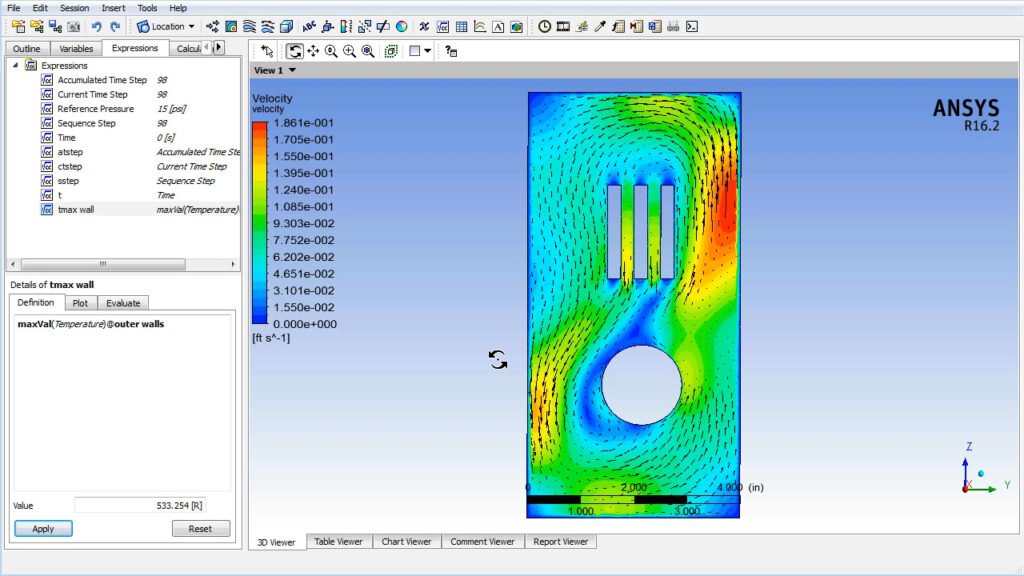
For example, pressure, velocity, temperature, and turbulence contours can reveal important information, but an engineer must interpret what those results mean for the actual design. The ability to connect simulation output with physical behavior is one of the most valuable skills an intern can develop.
Learning Verification and Validation
A professional simulation is not automatically correct simply because a solver reaches convergence. Verification and validation are essential parts of responsible CFD analysis.
During an internship, students can learn to check mesh sensitivity, monitor residuals, examine conservation quantities, and compare numerical predictions with experimental or analytical data when available.
Validation helps determine whether the simulation represents physical reality adequately for its intended purpose. Understanding these concepts can significantly improve an engineer’s credibility because it demonstrates awareness of the limitations of computational models.
Building a Strong CFD Portfolio
Internship experience becomes even more valuable when students document what they have learned. A professional portfolio can include academic projects, personal simulations, technical reports, mesh studies, validation exercises, and carefully presented results.
Students should focus on explaining the engineering problem, methodology, assumptions, simulation setup, findings, and conclusions. Screenshots alone are not enough.
A strong portfolio demonstrates problem-solving ability. For example, instead of simply showing a velocity contour, an applicant could explain how mesh refinement changed the predicted pressure drop and why the final mesh was selected.
When confidentiality permits, internship projects can also provide valuable experience for discussing technical work during job interviews. Confidential company information should never be shared without authorization.
Developing Communication and Teamwork Skills
Engineering careers involve more than technical calculations. CFD engineers regularly communicate with designers, experimental engineers, project managers, manufacturing teams, and other specialists.
An intern may need to explain simulation findings to someone who does not specialize in CFD. This requires clear communication and the ability to focus on practical conclusions.
Writing technical reports is another important skill. A good report should clearly describe the objective, methodology, assumptions, results, limitations, and recommendations.
These communication skills can make an applicant stand out because companies need engineers who can transform technical analysis into useful engineering decisions.
How to Find the Right Internship
When searching for a CFD internship, students should look beyond the job title. Some internships may involve genuine simulation work, while others may focus primarily on general engineering tasks.
Review the project description carefully and look for opportunities involving CFD modeling, fluid mechanics, heat transfer, simulation software, meshing, numerical analysis, or engineering automation.
Students should also prepare a targeted resume. Relevant university projects, CFD coursework, programming knowledge, CAD skills, laboratory experience, and technical competitions can all demonstrate preparation for an internship.
A concise portfolio can further strengthen an application by showing evidence of practical ability.
Turning an Internship Into a Career
A successful internship can create a pathway toward graduate engineering roles. The key is to treat the internship as a learning opportunity rather than simply a temporary position.
Ask thoughtful questions, document lessons learned, request feedback, and try to understand the reasoning behind engineering decisions. Developing relationships with experienced engineers can also provide valuable professional guidance.
After completing the internship, update your resume with measurable achievements where possible. Instead of writing that you “worked on CFD simulations,” explain the type of analysis performed, software used, engineering objective addressed, and skills developed.
Final Thoughts
A CFD internship can provide practical experience that complements academic knowledge and prepares aspiring engineers for professional simulation work. By learning the complete CFD workflow, developing software and analytical skills, understanding verification and validation, building a technical portfolio, and improving communication abilities, students can become stronger candidates for engineering positions.
The most valuable outcome of an internship is not simply familiarity with a particular software package. It is learning how to approach an engineering problem systematically, create a reliable computational model, interpret results critically, and communicate conclusions clearly. These capabilities can form a strong foundation for a long-term career in CFD and engineering simulation.