The Rise of Answer Engine Optimization: What Traditional SEO Missed
You spent years mastering keyword research, link building, and technical audits. Those skills drove real results. Now AI-powered answer engines are reshaping how users find information. Your hard-won expertise still matters. It just needs a new layer.
Answer engine optimization is the practice of making your content the source AI engines cite when users ask questions. It builds on SEO fundamentals while adding new requirements that traditional SEO never addressed.
What Traditional SEO Missed
Traditional SEO optimized for click-through. Get the user to your page. Answer engine optimization targets a different outcome: get your content cited in the answer itself. The user may never visit your site, but your brand earns authority and visibility in the response.
SEO professionals focused on ranking factors: backlinks, page speed, mobile usability, keyword placement. Answer engines care about different signals: claim clarity, source credibility, factual density, and cross-platform consistency.
The biggest gap is measurement. Traditional SEO has mature tools for tracking rankings, traffic, and conversions. Answer engine visibility tracking is still emerging. Teams that wait for perfect measurement tools before acting fall behind those who build imperfect tracking now.
The skills that made you a strong SEO professional are your foundation. Answer engine optimization is the next layer, not a replacement.
Criteria for Effective Answer Engine Optimization
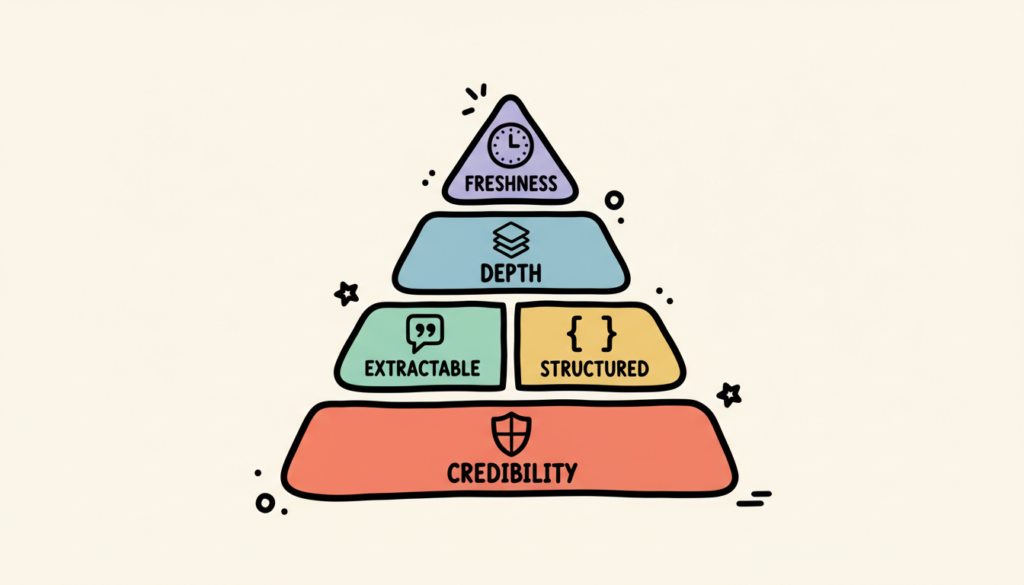
Source Credibility Across Platforms
Answer engines verify claims by checking multiple sources. Your site needs corroboration from third-party publications, review sites, and industry databases. A single authoritative domain is not enough. Build a citation network that AI engines can cross-reference.
Definitive, Extractable Statements
Every key page needs at least three clear, factual claims that a retrieval system can extract verbatim. Avoid burying claims in qualifiers. “Email marketing returns $42 per dollar spent” gets cited. “Email marketing can potentially return significant value” does not.
Structured Content With Semantic Markup
Answer engines parse structure first, content second. Proper heading hierarchy, schema markup, and consistent formatting signal that your content is machine-readable. A dedicated ai engine optimization approach includes structural audits as a core discipline, not an afterthought.
Topic Cluster Depth
Answer engines prefer citing sites that demonstrate deep expertise in a topic. A single blog post about email marketing will not compete with a site that has 30 interlinked pages covering every aspect of the topic. Build comprehensive topic clusters with clear internal linking.
Freshness and Update Cadence
Answer engines prioritize current information. Pages with outdated statistics, old dates, and stale references lose citation eligibility. Establish a quarterly update cycle for your highest-value content. Mark update dates clearly.
Practical Tips for SEO Veterans Adapting to AEO
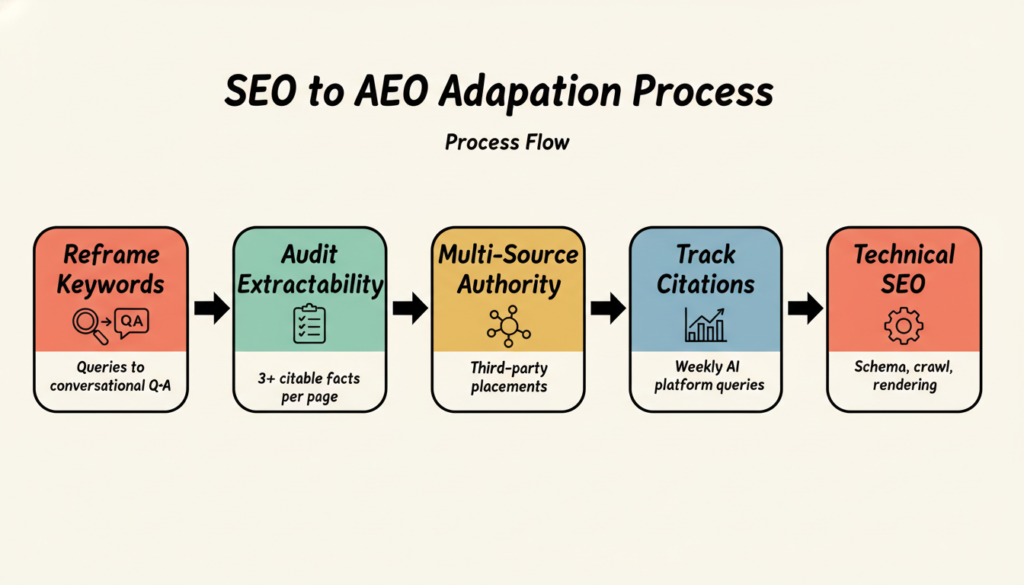
Reframe Your Keyword Research as Query Mapping
Traditional keywords map to search results pages. Answer engine queries map to synthesized responses. Expand your keyword lists to include conversational questions, comparison queries, and “best” queries that AI engines handle differently than Google.
Audit Your Content for Extraction Readiness
Read your top 20 pages and highlight every sentence that could stand alone as a cited fact. If you find fewer than three per page, the content needs restructuring. Add clear claims, data points, and definitive statements throughout.
Build Multi-Source Authority
Your link building skills translate directly to answer engine optimization. Instead of focusing only on domain authority, target placements on sites that AI engines frequently cite. Industry publications, educational resources, and data repositories carry outsized weight. This external presence is central to ai engine optimization because AI models trust corroborated claims over isolated ones.
Set Up Imperfect Tracking Today
Do not wait for perfect AEO measurement tools. Start with manual weekly queries across AI platforms. Log citations in a spreadsheet. Track trends. Imperfect data beats no data when your competitors are already measuring.
Leverage Your Technical SEO Skills
Schema markup, site architecture, crawl management, and rendering optimization all apply to answer engine visibility. Your technical SEO expertise gives you an advantage over marketers approaching AEO from a content-only perspective.
The Veterans Who Adapt Will Lead
SEO professionals have survived algorithm updates, mobile-first indexing, and core web vitals shifts. Each transition rewarded those who adapted early. Answer engine optimization follows the same pattern.
The practitioners who dismiss AEO as a fad will lose ground to those who treat it as the next evolution. Your existing skills are not obsolete. They are the foundation that makes your AEO work stronger than anyone starting from scratch.
The question is not whether answer engine optimization matters. It is whether you lead the transition or follow it. Every month of delay narrows the window to establish yourself as the expert who understood both worlds.